Header Ads

Friday, February 28, 2014

Nokia and HTC ended their prolonged legal war with a patent and technology collaboration agreement. The partnership ends all pending patent litigation between the two companies. Its full terms are confidential.


According to the official press release, HTC will make payments to Nokia, but the exact amounts havent been disclosed. The Finnish company on the other hand will gain access to HTC’s LTE patent portfolio, thus further expanding its own expertise. Furthermore, the companies will look into future technology collaboration opportunities.

Unsurprisingly, representatives from both Nokia and HTC are pleased with the agreement. By staying out of court and sharing patents, both companies will be able to focus on making products which can better compete in today’s crowded marketplace.

Source
Read More..
It is no news that Android apk apps converted to Blackberry Playbook bar files can run on the Blackberry Playbook device from the computer directly on the device using a desktop installer. This process is known as Sideloading.

For any reason, the App World may decide not to work or some apps may be restricted to some countries or region. With sideloading of apps to the Playbook, you can install already downloaded .bar files into your device and it will work. Better stil, you can convert an Android app in the apk format to .bar format that can be installed on your Playbook.

Follow www.apk2bar.unker.net to convert downloaded Android apk apps to Blackberry bar format.

Follow these steps to get your apps running on the Playbook

Needed items
  • wifi internet connection
  • bar files
  • Playbook (a more recent updated version)
Step 1
Download DDPBInstaller.msi here and the bar files you need from here

Step 2
Connect your device to the computer

Step 3
Swipe down the left side of the screen to reveal menus, select Security

Step 4
Switch on Developer mode. Note the IP address.

Step 5
Install DDPBinstaller and launch it. Put in the IP address in the IP address section and provide your devices password. Click connect

Step 6
Click Add at the top right side of  the window and add the bar files you downloaded.
Once added, tick and click on install.


Some files may not work even after installing if you device isnt upgraded to the latest OS.


I hope this works for you. Drop a comment to let us your success.

Read More..

Thursday, February 27, 2014

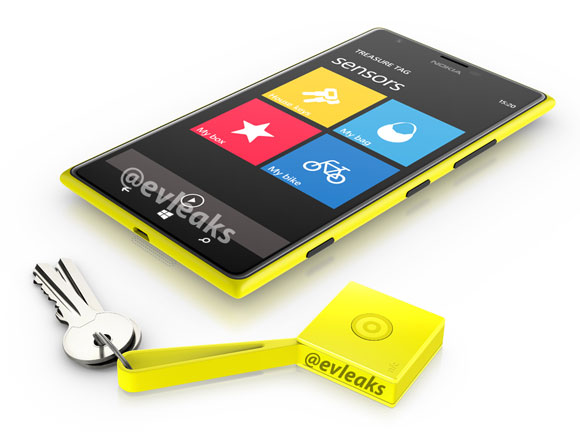
A couple of leaked images delivered by evleaks have shown a few of tomorrows Nokia announcements including the Lumia 1520 phablet. The handset is joined by a couple of accessories - the Treasure Tag key finder and the Nokia Guru music player.

The first leak shows the Nokia Lumia 1520 from a new angle, that lets us get a better idea of the slim profile of the device. Judging from the photo, its going to be as thin, if not thinner, than the Lumia 1020 cameraphone. Unconfirmed information states the Lumia 1520 will likely feature a 6" display, 20 MP camera and 3,390 mAh battery.
The Nokia Lumia 1520 will feature a potent quad-core Snapdragon 800 processor and FullHD 1080p display, who gained support for WP8 a couple of days ago with the GDR 3 update. The Nokia Glance Background will also be on board.
As far as the accessories go, the Nokia Treasure Tag is a little keychain device which resembles the HTC Fetch you might have seen. Basically, you hook it to your keys and then use the phone to make it ring and locate them when needed.
It seems that the Treasure Tag is working via Bluetooth and features a single button on the top side. The leaked photo reveals the yellow version, but we suspect Nokia will also have it in other colors. There’s also a specially designed Treasure Tag app for Windows Phone 8 to go along with the accessory.
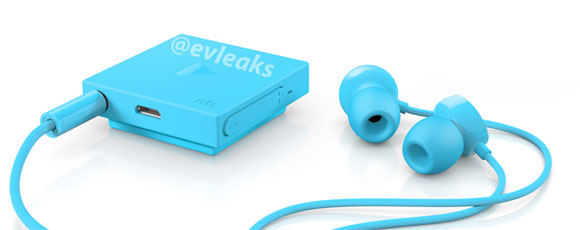
The second leaked photo shows what looks like a music player device called Nokia Guru. The notable leakster also posted a product photo to go along with his tweet.

It’s not clear whether this name is the final one or if it’s a codename, but the Guru looks quite small. As you can see from the photo above it’s a bit larger than the pair of headphones. As the leaked photo shows, the Guru will connect to a computer via microUSB port and there’s a volume rocker on its right side. The 3.5mm headphone jack is alongside the microUSB port on the bottom.
The Nokia Guru will probably also be offered in multiple color schemes, but that’s mostly a speculation at this point. Here’s hoping Nokia won’t charge an arm and a leg for it.
The Nokia Lumia 1520 and the two accessories are expected to debut tomorrow at the Nokia event in Abu Dabi.
The live stream from the event will be broadcast right here on Conversations and begins at 11am local time (Abu Dhabi is at UTC + 4 hours).


 GSMArena
Read More..
Hands on: Nikon Df review 


Not yet rated

For

  • Full-frame sensor
  • Small body
  • Traditional controls
  • Weatherproof

Against

  • Only 16MP
  • No video recording
  • Expensive

The teasing stops and we get our hands on Nikons retro DSLR

Unusually, in the run up to the announcement of the Nikon Df weve been treated to a series of video teasers. But now the excitement will really start because weve finally seen the whole camera and its a retro beauty.
Perhaps the biggest surprise with the Df is that Nikon has gone for a 16.2 million-pixel FX (full-frame) CMOS sensor. Some might have been hoping for a 24.3MP sensor like the Nikon D610 or a 36.3MP sensor like the Nikon D800, but Nikon has opted to use the same sensor as in the Nikon D4.

Nikon Df
Dials, lots of dials

However, the benefit of opting for a 16MP sensor is that the photosites themselves are bigger and this means that they receive more light and generate a stronger signal which requires less amplification. As a result less noise is generated, so that images are cleaner.

Data from the sensor is processed by the EXPEED 3 processing engine, the same engine as is found in the Nikon D610, D800 and D4. This allows the sensitivity to be set in the native range ISO 100-12,800, with expansion settings pushing to ISO 50-204,800. Thats a match for the D4.

Meanwhile theres a maximum continuous shooting rate of 5.5fps for up to 100 images and images are stored on an SD/SDHC/SDXC card. Unlike Nikons other FX format cameras, theres only one card port in the Df.

Nikon Df
Only one card slot lurks behind the covers

While the Dfs body may be new (well retro really), the majority of its components are familiar.
The AF system is the for example, uses the same Multi-CAM 4800 module as the D610 and has 39 AF points, 9 of which are cross-type. The 2,016-pixel RGB sensor that gathers information for the Automatic Scene Recognition System and informs the white balance, focusing and metering systems is also familiar.

On the back of the camera theres a 3.2-inch 921,000-dot LCD screen just like the D610s. In live view mode this can display a nine-cell grid that conforms to the rule of thirds and the scene can be cropped to give 1:1 or 16:9 format.

Nikon Df
The screen is the same size as the D610s

As its an SLR rather than a compact system camera, the Df has an optical viewfinder which shows the image seen through the lens. This provides a 100% field of view and has 0.7x magnification as well as DX crop markings for when DX lenses are mounted.
A dual-axis digital level can display roll (horizontal inclination) and pitch (forward or backwards inclination) in the LCD, while roll can also be displayed in the viewfinder, making it easier to get level horizons.

In a unique move, Nikon has given the Df a collapsible metering coupling lever that enables old non-AI Nikkor lenses to be mounted directly onto the camera.
Full-aperture metering is possible with non-AI lenses when shooting in aperture priority or manual exposure mode – just like AI lenses, which have full-aperture metering in all exposure modes.

On the subject of exposure modes, the Df can shoot in program, shutter priority, aperture priority and manual exposure modes, theres no fully automatic option or scene modes. There is, however, the usual complement of Picture Control modes so its possible to vary the appearance of JPEG files and produce monochrome images in-camera if you want.

Nikon Df review

There are a couple of features that are notably missing from the Df, the first is a pop-up flash – although this is hardly surprising given the cameras retro styling and pro credentials and there is a hotshoe. Whats more the Df is compatible with Nikons Creative Lighting System . The second omission is the ability to record movies. Yes, its a stills-only camera.

The fact that theres no Wi-Fi connectivity built-in is unsurprising, but the Df is compatible with Nikons WU-1a Wireless Mobile Adaptor that enables images to be transferred wirelessly to a smartphone or tablet. It can also be used with Nikons WR-R10 Wireless transceiver and WR-T10 Wireless Transmitter which allow remote control over the camera.

Build and handling

While it is quite chunky, the Df is noticeably smaller than the D610. It also has a more angular design, based on the FM2, and a larger pentaprism housing.
Although the link to past Nikon SLRs is clear, modern materials and small elements of design give away that the Df is a modern camera. Its superbly retro, yet is weather sealed to the same standard as the Nikon D800.

Nikon Df
We suspect the word retro will be used a lot

Nikon wants using the Df to be as important and enjoyable as the images it creates. Key settings such as shutter speed, sensitivity and exposure compensation are all set by dials on the top-plate. However, the shutter speed dial has a 1/3 Step setting which when selected allows users to adjust shutter speed using the rear command dial above the thumbrest.

A locking button at the centre of the exposure compensation dial on the left and on the shutter speed dial on the right must be pressed before either of the dials can be rotated. Similarly, theres a lock button the side of the sensitivity dial, which sits below the exposure compensation dial.

There are also X,T and B settings which stand for flash sync, timed exposure (the shutter stays open until the release is pressed a second time) and bulb exposure (the shutter stays open as long as the release is held down. In another nice touch the shutter release has a thread at its centre to accept a traditional-style cable release.

Nikon Df
The top plate is well populated

On the right of the top-plate as you hold the camera theres a mode dial marked MASP. This dial is necessary because the Df is compatible with modern lenses that dont feature an aperture ring as well as older ones that do.

Focus mode is set in the same as on Nikons other recent SLRs, via a switch to the side of the lens mount. This switch has a button at its centre which when pressed and used in conjunction with the front and rear control dials allows the AF options (Single-AF, Continuous-AF, etc) to be selected.
Its nice to see a return to a switch on the back of the camera to set the metering mode, and a button on the front of the camera which is used in conjunction with the command dials to set the bracketing options.

Performance

As yet weve only been able to use a pre-production sample of the Nikon Df and weve not been allowed to examine any images that weve taken with it on a computer screen, so we will have to wait until we get a full production sample in for testing before we can pass judgement on the quality of the images that it produces. However, given that it has the same sensor and image processor as Nikons range-topping SLR, the D4, it seems a fairly safe bet that its going to be a good performer.

By keeping the pixel count of the Df down to 16Mp rather than pushing it to 24 or 36-million pixels Nikon has put the emphasis on low light capability. This makes it a very versatile camera thats capable of shooting in a wide range of conditions.

Nikon Df
With the same sensor as the D4, image quality should be high

We expect to see that noise is controlled extremely well even when the sensitivity is pushed to ISO 12,800.
Not surprisingly, given its the same unit as inside the D4, the Dfs viewfinder is nice and bright, and capable of showing plenty of detail. This will be appreciated by owners with a collection of manual focus lenses.

When time allows, live view provides the best view for manual focusing as the enlarged view enables the focus to be placed very precisely. The Dfs screen is detailed and clear, but we will have to wait and see whether it suffers from the same problem as the D610s screen and overemphasises the cool tones in some scenes. In worst-case scenarios this can result in a change in white balance settings to one that produces overly-warm images.

We anticipate the metering system being reliable in most conditions. Weve tested Nikons 2,016-pixel RGB sensor and Scene Recognition System extensively and found it performs well in most situations. It has only thrown up a few surprises in the Nikon D7100 where we found the exposure compensation control is required more often than usual with most Nikon SLRs.

Early verdict

Read More..

Wednesday, February 26, 2014

Flagships


So 2014 is officially under way. And we’ve already seen quite a few rumors about upcoming flagships from the likes of Samsung, HTC, and LG. We know that Samsung is going to announce the Galaxy S5 this quarter, and LG should be announcing the new LG G Pro as well as HTC’s successor to the One. Which makes the beginning of the year pretty exciting. But that’s not all. There’s also the Sony Xperia Z2 coming at Mobile world Congress, most likely, as well as flagships from other OEMs out there like Motorola, Huawei, and ZTE. Then in the second half of the year we’ve got the Galaxy Note 4 coming and the LG G3.


The beauty of Android here is that we aren’t stuck with just one phone (Apple) or one OEM (Microsoft) for new phones. Some of us may love Samsung, some may love HTC, some may love LG or Motorola. But the beauty is that we have choice. I know we have some readers who will only buy Samsung, or only buy Nexus, or only buy HTC devices. As for me, I normally stick to stock Android devices like the the Moto X and the Nexus 4. But that doesn’t mean I’m not looking forward to seeing what Samsung and HTC have in store for us. As much as I’m not a huge fan of Samsung, I am actually excited to see what they have planned for the Galaxy S5. Since it appears they are finally updating the look of Touchwiz, and there’s rumors of a new hardware design as well. Then there’s HTC, whom I’ve always loved their hardware build, but it doesn’t seem like many others do.


So with that said, we want to know what flagships, or OEMs are you most looking forward to seeing this year? Are you eagerly awaiting the “Next Big Thing” from Samsung? Do you live in your own world but play in Sony’s? Perhaps you’re the HTC loyalist that would do anything to see them live on. Or maybe, just maybe, you’re a purist, and won’t buy anything that doesn’t come straight from Google. Perhaps one of the Chinese OEMs like Xiaomi or Meizu? Be sure to vote in the poll, and/or comment below.


The post Thursday Poll: What Flagship Are You Most Looking Forward to in 2014? appeared first on AndroidHeadlines.com |.


via AndroidHeadlines.com | http://ift.tt/1c8M9yz
Read More..